
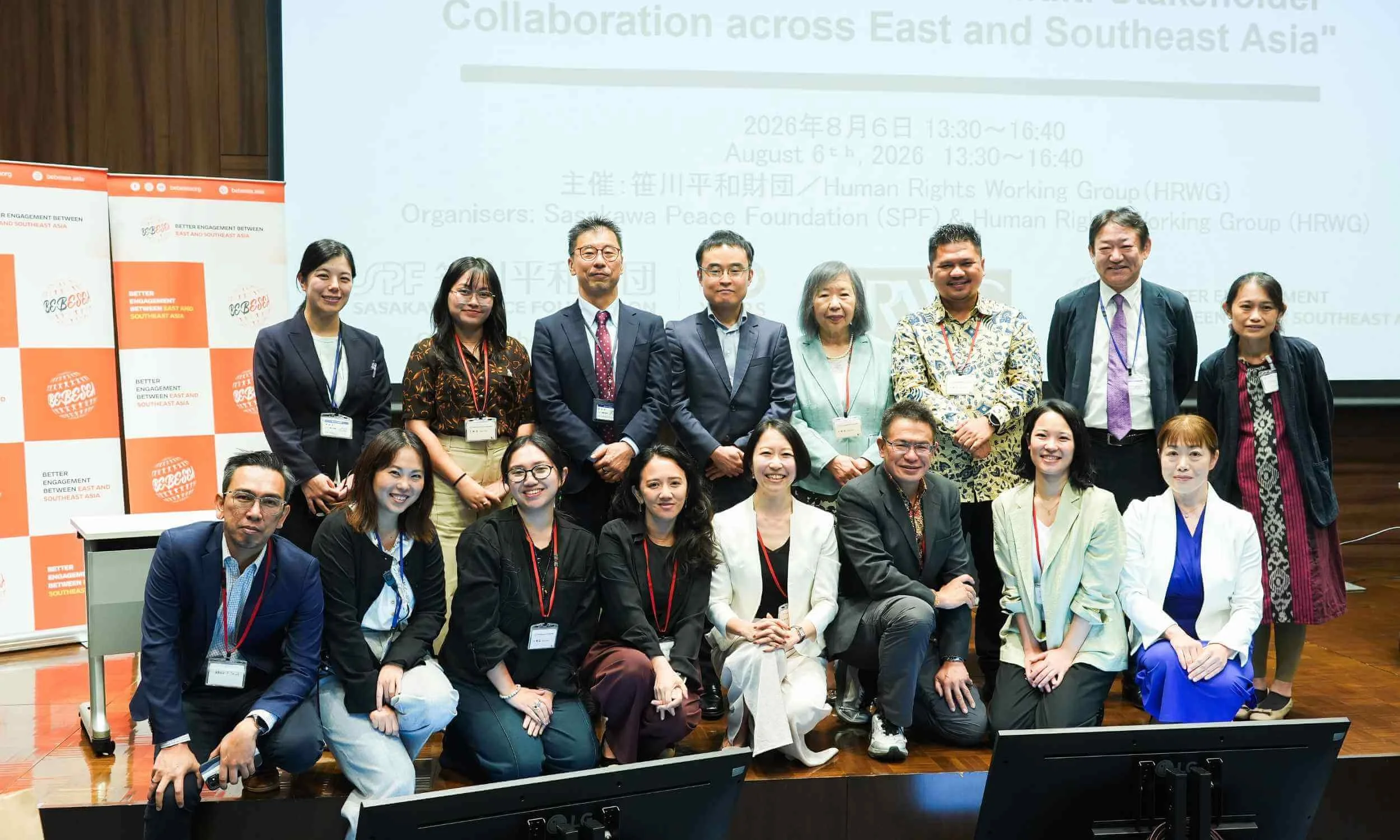
On August 6, 2026, a Symposium titled “Co-creating Inclusive and Sustainable Migration Governance: Lessons from Multi-Stakeholder Collaboration across East and Southeast Asia” was held and co-hosted by Human Rights Working Group (HRWG) and the Sasakawa Peace Foundation (SPF), marking their 8-year partnership that has led to the establishment of Better Engagement Between East and Southeast Asia (BEBESEA).
Joined by 45 participants onsite at the SPF Building in Tokyo and 189 others online, this symposium featured advocates, academics, policy experts, and civil society leaders to address one of the region's most pressing challenges: building migration governance in which where migrant workers are recognized not merely as economic input, but as rights-holders and partners. The event aimed to deepen understanding, foster dialogues, and support meaningful multistakeholder engagement in shaping migration governance that is effective, sustainable, and grounded in lived experiences.
Context and Purpose of the symposium
Across Asia and globally, expectations for governments and businesses to uphold human rights in migration governance are evolving rapidly. Countries are strengthening labour mobility systems and introducing new due diligence requirements following the development of international frameworks on Business and Human Rights.
Japan is also in its pivotal transition period. It is reforming its migrant labor system, including the shift from the Technical Intern Training Program (TITP) to the new Employment for Skills Development (ESD) system. It is also developing its second National Action Plan on Business and Human Rights.
The symposium was opened with remarks by Itsu Adachi, Executive Director of SPF.Following the opening remarks, Daniel Awigra, Executive Director of HRWG and Co-Founder of BEBESEA, provided the audience with the in-depth background and purpose of the symposium, framing the context of Asia’s migration landscape. Awigra emphasized the need for stronger cross-regional civil society cooperation to address systemic vulnerabilities experienced by migrants, including debt bondage, labour exploitation and barriers to justice, while advancing the protection of human rights of communities impacted by migration and implementation of Business and Human Rights (BHR) standards.
Awigra invited the audience to explore some questions throughout the symposium: “How do we ensure that human rights finally can be felt by the workers at the very bottom of the supply chain? How do we move beyond consultation toward very meaningful participation? When we look at the future of labor and business across East and Southeast Asia, how do we turn complex policies into actual protection for rights holders?”
Bridging policy and grassroots realities
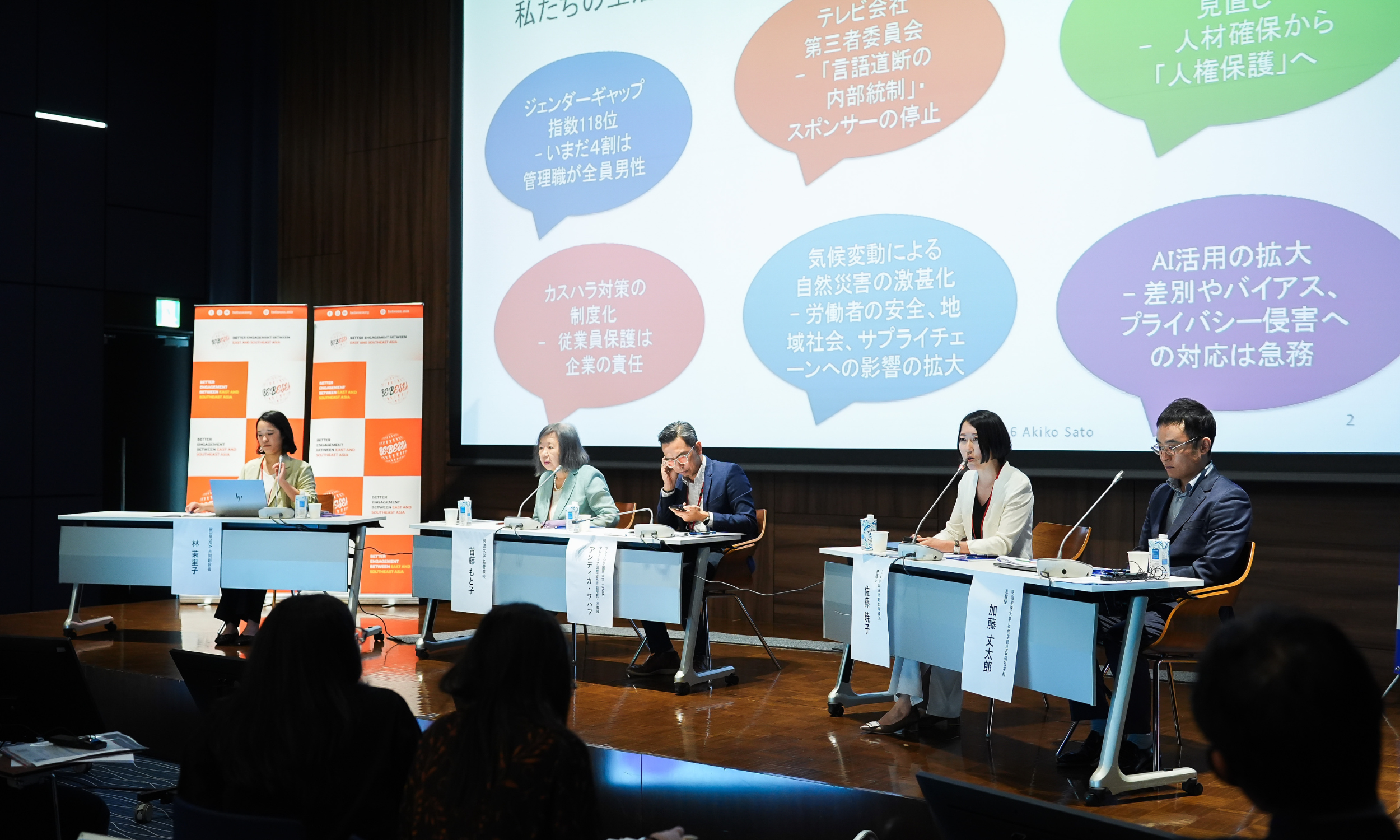
Session 1: Global, Regional, and Japan Context: Evolving Migration Governance & Business and Human Rights
Speakers: Prof. Motoko Shuto (Tsukuba University), Dr. Andika Wahab (UKM), Ms. Akiko Sato (Kotonoha Law) and Dr. Jotaro Kato (Meiji Gaikujin University)
The first panel was aimed at establishing a global, regional and national landscape of migration governance and Business and Human Rights.
Prof. Motoko Shuto presented the history of ASEAN’s framework developments related to migration and the trend of East Asian countries, highlighting recent developments, challenges and opportunities as well as the roles of civil society . Dr. Andika Wahab then explored ASEAN’s human rights mechanism and the roles of ASEAN Intergovernmental Commission on Human Rights (AICHR) in relation to the protection of migrant workers and Business and Human Rights. Ms. Akiko Sato outlined the international landscape and developments on Business and Human Rights and challenges and opportunities for ethical business conduct and due diligence, and the importance of grass-roots engagement. Dr. Jotaro Kato explained Japan’s labour migration systems and provided crucial perspectives on how the country’s policies influence the decision-making of migrants, reflecting on his extensive research on migrant agency.
The session laid a foundation for session two by highlighting multi-stakeholder responsibility and the importance of meaningful participation and engagement in policymaking and business practice.
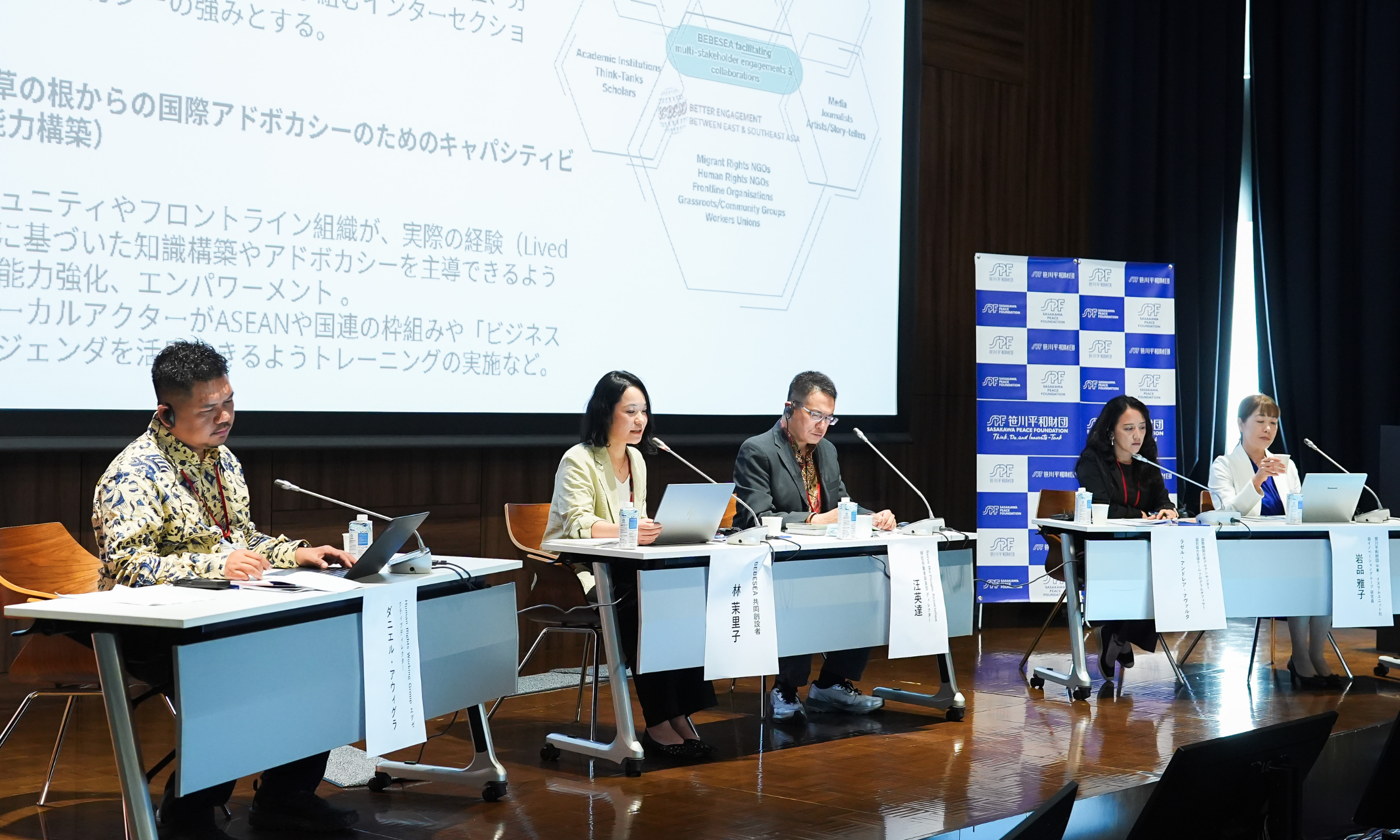
Session 2: Lessons from Community-Centered Collaboration
Speakers: Ms. Mariko Hayashi (BEBESEA), Mr. Lennon Ying Dah Wang (SPA), Dr. Razel Navalta (ASEAN-Japan Center) and Ms. Masako Iwashina (SPF)
The session is anchored in BEBESEA’s one of its missions: Strengthening multi‐stakeholder collaboration through an intersectional and community-centered approach to drive systemic change. We truly believe that in order to uphold human rights, there must be meaningful participation of impacted communities.
Ms. Mariko Hayashi, co-founder of BEBESEA, introduced BEBESEA, a cross-regional advocacy platform that facilitates multi-stakeholder collaborations to address human rights challenges in East and Southeast Asia, through sharing our foundational approaches and strategic actions. Using the case study of BEBESEA’s advocacy with migrant fishers, she demonstrated how our approaches and strategic actions come together to drive changes. Mr. Lennon Ying-Dah Wang discussed the challenges and organizing efforts of migrant workers in Taiwan, reflecting on SPA’s work providing shelter and casework support to migrant workers, while helping migrant workers to unionise. Highlighting the close economic tie between Taiwan and Japan, he encouraged Japanese and Taiwanese actors to strengthen cooperation for the protection of migrant workers. Ms. Razel Navalta presented BEBESEA’s Participatory Action Research (PAR) on social protection,which Kakehashi, a Filipino community group in Japan, was one of the collaborating partners. Illustrating the persistent gaps on the accessibility of social protection and the gaps between formal policy and actual implementation found in the research, as well as her current work at ASEAN-Japan Centre, she emphasised that “governance only becomes inclusive when the people it's meant to serve have a real channel into shaping it — not just receiving it.” Ms. Masako Iwashina’s presentation detailed SPF’s migration programs, and provided examples of their working with migrant groups to develop community-led orientations for new migrants in Japan.
The panel presented evidence, lived experience insights, and reflections of the collaborative efforts of civil society-led multi-stakeholder collaboration in East and Southeast Asia. Lessons learned from BEBESEA and its key collaborators such as SPF, Kakehashi and SPA informed the audience how community-centred knowledge and initiatives can influence and inform policy and business practice.
Read the Executive Summary at SPF website (English | Japanese).
Celebrating and Sharing BEBESEA’s work and Eight Years of Impact
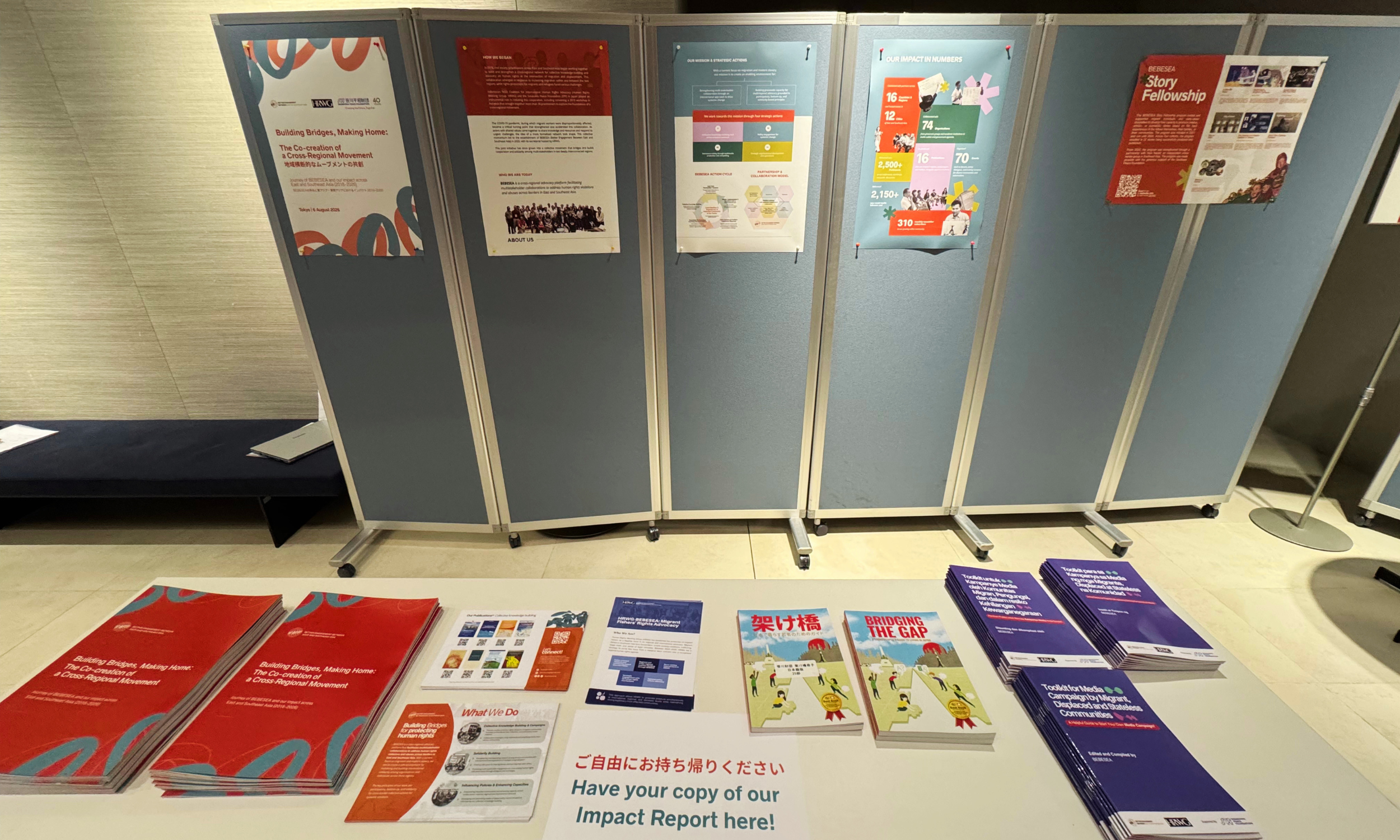
As announced by the co-founders of BEBESEA in this event, we launched our first impact , “Building Bridges, Making Home: The Journey of BEBESEA and Our Impact (2018–2026).”
This report elaborates eight years of cross-border and multi-stakeholder collaboration initiatives of migrant communities, civil society organizations, researchers, policy makers, media practitioners and many other stakeholders across East and Southeast Asia. Highlighting BEBESEA’s core approaches and strategic actions, the report showcases various initiatives, and how these approaches and actions come together to drive changes through connecting grassroots realities with policy processes and systemic solutions.
The symposium also provided an opportunity for BEBESEA to share its work through an exhibition held outside of the International Conference Hall at SPF building where the event was held. Participants were able to see our work through posters and our publications produced as research reports, story-telling booklets, and policy papers. The networking session followingr the symposium sessions provided opportunities for the panelists, BEBESEA and SPF teams and the onsite participants to exchange, learn from each other’s work and expand networks.
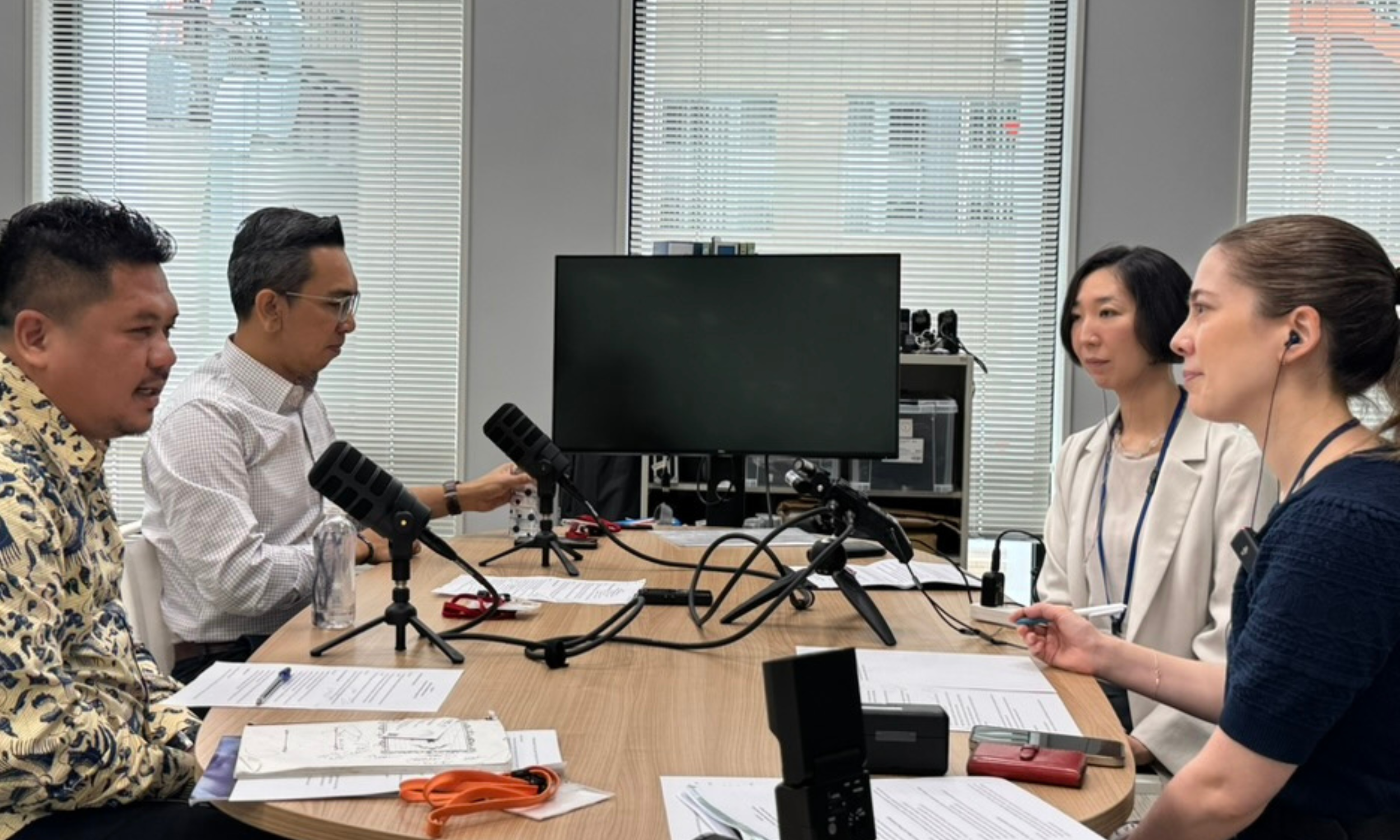
In addition, Daniel Awigra, Lennon Ying-Dah Wang and Andika Wahab were interviewed by the SPF’s PR team for their podcast episodes. Two podcast episodes discuss ASEAN Human Rights mechanisms and situations of migrant workers in East and Southeast Asia, and the role of civil society in these fields. These episodes will be released in autumn.
Takeaways
Overall, the symposium became a great platform for connecting East and Southeast Asia by showing the importance of regional collaboration with multi-stakeholders.
The post-event survey shows that over 95% of respondents felt “very satisfied” and “satisfied” with the event, and we were encouraged by a number of positive pieces of feedback.
“(…) I felt a glimmer of hope in the work being done on the ground by researchers and research groups.”
“It was an opportunity to learn about problems I never even thought about. Thank you very much.”
“Good two panel discussions from academic perspective in the first session to practitioner in the second one. (…)”
As migration becomes one of the major and complex political issues in many countries, recognizing the vital economic and social contributions of migrant workers and including them in the development of sustainable migration governance are crucial. Through this series of activities in Tokyo, we renewed our commitment to continue fostering multi-stakeholder collaborations and building cross-regional solidarity.
